

Macular Degeneration
- Home
-

- Macular Degeneration


Preserve Your Independence
Macular Degeneration and Daily Life
Macular degeneration doesn’t just affect your eyes, it impacts everyday living. From reading to driving, central vision is vital for independence. Addressing macular degeneration early with lifestyle adjustments and treatment can help maintain clarity and confidence in daily activities.
Clarity Starts Here
What Is Macular Degeneration?
Macular degeneration is a deterioration or breakdown of the macula. The macula is a small area in the retina at the back of the eye that allows you to see fine details clearly and perform activities such as reading and driving. When the macula does not function correctly, your central vision can be affected by blurriness, dark areas or distortion. Macular degeneration affects your ability to see near and far, and can make some activities like threading a needle or reading difficult or impossible.
Although macular degeneration reduces vision in the central part of the retina, it does not affect the eye’s side, or peripheral, vision. For example, you could see the outline of a clock but not be able to tell what time it is.
Macular degeneration alone does not result in total blindness. Even in more advanced cases, people continue to have some useful vision and are often able to take care of themselves. In many cases, macular degeneration’s impact on your vision can be minimal.

Protect Your Vision
Macular degeneration is a leading cause of central vision loss, gradually reducing clarity and detail. Early detection and treatment help preserve independence and protect long-term sight.
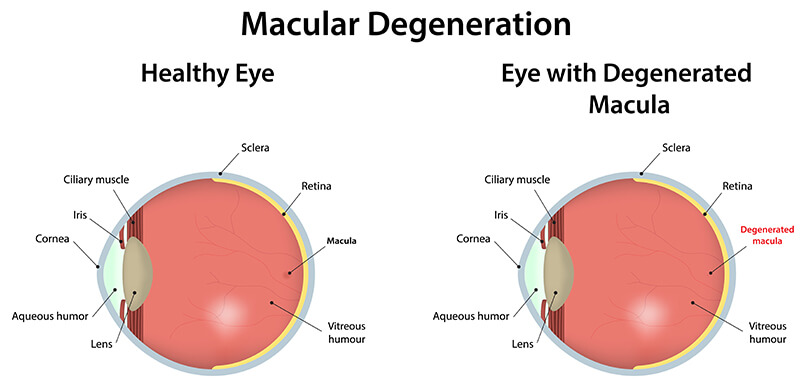
Understanding AMD
What Causes Macular Degeneration?
Many older people develop macular degeneration as part of the body’s natural aging process. There are different kinds of macular problems, but the most common is age-related macular degeneration (AMD). Exactly why it develops is not known, and no treatment has been uniformly effective. Macular degeneration is the leading cause of severe vision loss in Caucasians over 65.
Most Common Types of AMD
In the normal macula, nutrients are able to pass from the network of blood vessels underneath the retina (choroid) into the retina. Waste products from retinal metabolism are able to pass easily out of the retina and be carried away by the blood vessels of the choroid.
Dry Macular Degeneration (Atrophic)
As aging occurs, so does the most common form of AMD, the “dry” form. In dry AMD, waste products from retinal cells are deposited in the retinal tissues below the retina. These waste products appear to the ophthalmologist as yellowish deposits called drusen. These waste products block nutrients from the underlying blood vessels (choroid) from reaching the metabolically active retinal cells. In this condition, visual loss is very gradual.
Wet Macular Degeneration (Exudative)
The “wet” form of macular degeneration accounts for about 10 percent of all AMD cases. It results when abnormal blood vessels form underneath the retina at the back of the eye. These new blood vessels leak fluid or blood and blur central vision. Vision loss may be rapid and severe.
What Are the Symptoms of Macular Degeneration?
Macular degeneration can cause different symptoms in different people. The condition may be hardly noticeable in its early stages. Sometimes only one eye loses vision while the other eye continues to see well for many years.
But when both eyes are affected, the loss of central vision may be noticed more quickly.
Following are some common ways vision loss is detected:
- Words on a page look blurred
- A dark or empty area appears in the center of vision
- Straight lines look distorted, as when looking at an “Amsler Grid”
How Is Macular Degeneration Diagnosed?
Many people do not realize that they have a macular problem until blurred vision becomes obvious. Your ophthalmologist can detect early stages of AMD during a medical eye examination that includes the following:
- A simple vision test in which you look at a chart that resembles graph paper called an “Amsler Grid” – there is one down further on this page.
- Viewing the macula with an ophthalmoscope
- Taking special photographs of the eye called fluorescein angiographs to find abnormal blood vessels under the retina.


How Is Macular Degeneration Treated?
Macular degeneration cannot be cured, but today’s treatments can slow its progression, preserve vision, and in some cases improve quality of life. The right approach depends on the type of macular degeneration—dry or wet—as well as the stage of disease and individual patient needs. At Desert Vision Center, Dr. Keith Tokuhara uses evidence-based treatments tailored to each patient.

Nutritional Supplements & Lifestyle Support
For early stages of dry macular degeneration, nutritional support plays a critical role. The Age-Related Eye Disease Study (AREDS2) demonstrated that specific antioxidant vitamins and minerals—including vitamin C, vitamin E, zinc, copper, and lutein/zeaxanthin—can reduce the risk of progression to advanced disease by about 25% in certain high-risk patients. Supplements are not a cure, and they cannot restore vision already lost, but they are an important tool for slowing down the disease.
In addition to supplements, lifestyle modifications are strongly encouraged. These include quitting smoking, managing blood pressure and cholesterol, wearing UV-protective eyewear outdoors, and eating a diet rich in leafy greens, colorful vegetables, and omega-3 fatty acids. Together, these measures help reduce oxidative stress and support long-term retinal health.

Injections for Wet Macular Degeneration
Patients with the wet form of macular degeneration typically require more aggressive treatment. The most effective option is intravitreal injection of anti-angiogenic medications. These drugs block abnormal blood vessels from growing under the retina and reduce leakage that causes swelling and rapid vision loss.
Treatment involves injecting medication directly into the eye during a quick, in-office procedure that takes only minutes and is generally well-tolerated. Injections are often repeated on a regular schedule—sometimes monthly or bimonthly—depending on how well the disease responds. Many patients experience stabilization of their vision, and some even achieve improvement with consistent therapy. Early detection of wet macular degeneration is essential, as beginning injections promptly offers the best chance of preserving sight.

Surgical & Advanced Options
For select patients with advanced, end-stage macular degeneration, surgical innovation may provide additional options. One such treatment is the implantable miniature telescope, placed during cataract surgery. This tiny device magnifies images onto healthier areas of the retina, helping patients regain functional central vision.
Because the telescope changes the way patients use their vision, it requires rehabilitation with low-vision specialists after surgery. Candidates are carefully evaluated to ensure the procedure will provide meaningful improvement.
Low-Vision Support
Even with treatment, some patients experience vision loss. In these cases, low-vision aids such as magnifiers, large-print materials, or talking devices can help maximize remaining sight and maintain independence.
Testing Your Vision With the Amsler Grid
You can check your own vision daily by using an Amsler grid. You may find changes in your vision that you wouldn’t notice otherwise. Putting the grid on the front of your refrigerator is a good way to remember to look at it each day.
To use your Amsler grid:
- Wear your reading glasses and hold this grid 12 to 15 inches away from your face in good light.
- Cover one eye.
- Look directly at the center dot with the uncovered eye.
- While looking directly at the center dot, note whether all lines of the grid are straight or if any areas are distorted, blurred or dark.
- Repeat this procedure with the other eye.
- If any area of the grid looks wavy, blurred or dark, call our office

Frequently Asked Questions:
Macular Degeneration

Macular degeneration is a progressive eye disease that damages the macula, the part of the retina responsible for central vision. It can cause blurred, distorted, or dark spots in your vision, making activities like reading and driving difficult.

Early symptoms may include blurry central vision, difficulty reading, trouble recognizing faces, faded colors, or seeing straight lines as wavy. Because vision loss is gradual, many patients do not notice symptoms until the disease has progressed.
The exact cause isn’t fully understood, but age, genetics, smoking, and conditions like high blood pressure or high cholesterol increase risk. Long-term UV exposure and poor diet may also contribute to its development.
There is currently no cure. However, early detection and treatment can slow progression. Treatments may include lifestyle changes, nutritional supplements, medications, or eye injections for the more advanced “wet” form of the disease.
An eye doctor can diagnose macular degeneration with a dilated eye exam and specialized imaging, such as optical coherence tomography (OCT) or fluorescein angiography. Regular checkups are essential, especially for adults over age 55.
Attention Patients
Dear Valued Patients of Desert Vision Center,
Dr. Tokuhara is a highly skilled cataract surgeon, specializing in advanced anterior segment surgeries, including complex glaucoma and cataract procedures. He focuses on patients who need surgical intervention or are at risk of severe vision loss.
While Dr. Tokuhara offers comprehensive eye care for his own surgical patients, he does not provide general eye care or post-operative care for patients of other surgeons. When you choose Dr. Tokuhara, he becomes your trusted eye doctor for life. A Note About Ethical Care
In our community, some providers engage in illegal financial kickbacks accepting payments for cataract surgery referrals. Desert Vision Center firmly rejects this unethical practice. We follow the highest ethical standards, complying with the Anti-Kickback Statute and Stark Law, ensuring that your care in never influenced by financial incentives.
We believe referrals should always be based on what’s best for the patient—not financial gain. If you’re being evaluated for cataract surgery, we encourage you to ask questions and be mindful of these referral arrangements.
Choose the surgeon who prioritizes your vision and your well-being—not one chosen for someone else’s profit.
Sincerely,
Desert Vision Center