

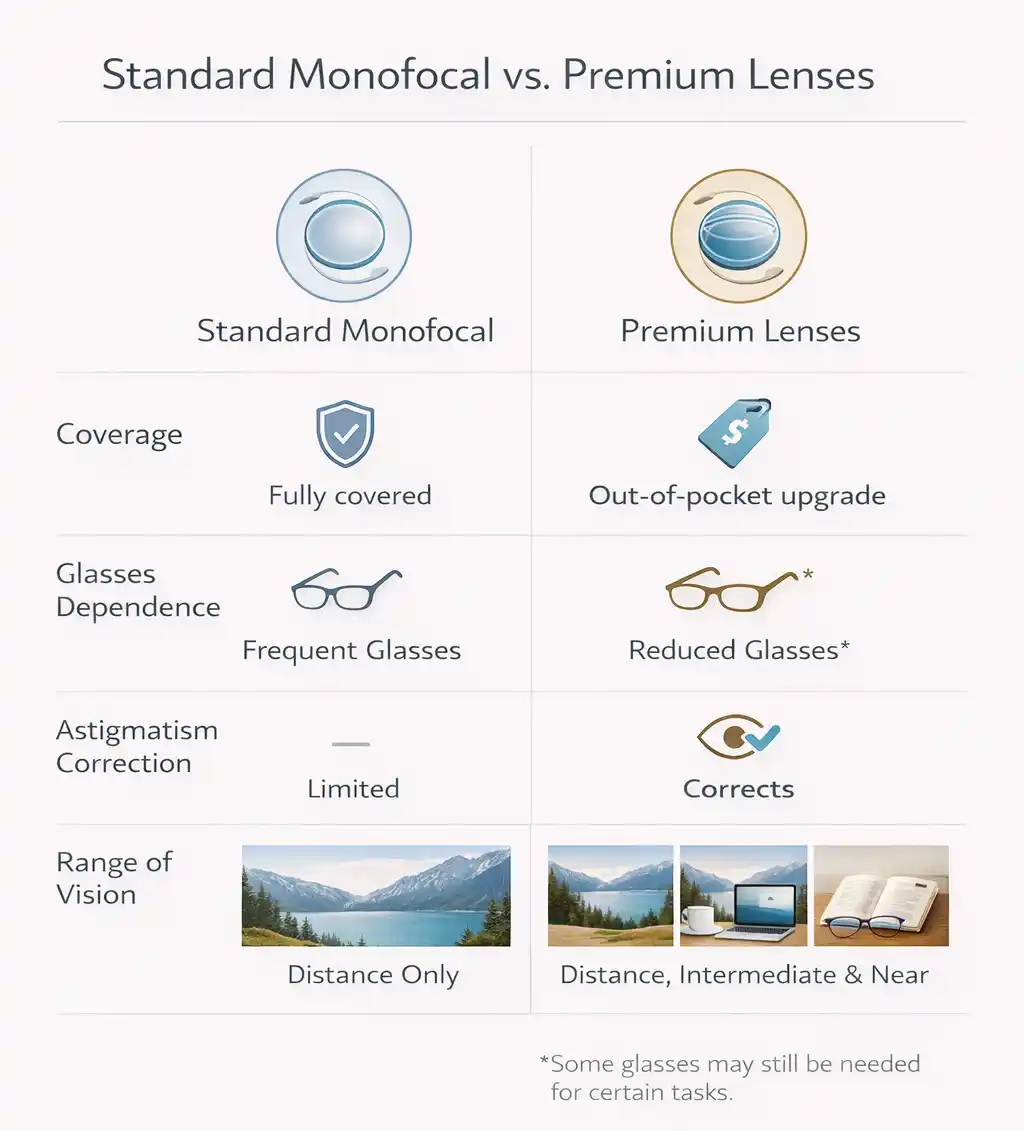
- Standard monofocal IOLs are typically the covered baseline option and usually provide clear vision at one main distance.
- Premium lenses are elective upgrades designed to broaden vision range, reduce glasses dependence, correct astigmatism, or offer more customized refractive planning.
- Multifocal and EDOF lenses may reduce dependence on glasses, but they are not a perfect fit for everyone.
- Toric lenses often have one of the clearest value cases because they address astigmatism during cataract surgery.
- Medicare generally covers cataract surgery with a conventional IOL, while advanced-lens upgrades usually involve additional out-of-pocket spending.

Why This Question Matters
Cataract surgery is no longer just a cloudy-lens removal procedure. It is also a refractive choice. Patients are not only asking whether surgery will restore clarity. They are also asking how they want to see afterward.
That is why the worth-it question is valid and important. Standard monofocal lenses are usually covered, but advanced lenses that correct presbyopia or astigmatism are typically treated as elective upgrades with added out-of-pocket cost.
What Counts as a Premium Cataract Lens?
A standard monofocal lens is the traditional cataract-surgery lens. It typically provides clear vision at a single distance, and many patients choose distance correction and use reading glasses as needed.
Premium cataract lenses are advanced intraocular lenses designed to do more than that standard covered baseline. These can include multifocal and EDOF lenses for a broader range of vision, toric lenses for astigmatism, and additional advanced-IOL options guided by individualized planning.
In practical terms, premium does not mean one product. It means a family of elective upgrades aimed at reducing glasses dependence, correcting astigmatism, broadening functional vision, or improving refractive customization.
What You Are Really Paying For
The easiest mistake in this topic is assuming patients are just paying for a better lens. In reality, they are usually paying for a different visual target. Standard monofocal lenses typically give one main focal distance. Advanced lenses may aim to reduce dependence on glasses, correct astigmatism, broaden useful vision range, or improve refractive precision.
That extra cost is often tied to daily-life goals: driving, screens, reading menus, using a phone, golf, travel, and not constantly swapping between different pairs of glasses.
A real cost-versus-value breakdown has to stay honest. Premium cataract lenses are not automatically worth it because they are newer or more expensive. They are worth it when the functional payoff is large enough for the patient to feel it every day.
Cost vs Value Comparison
| Decision factor | Standard monofocal lens | Premium cataract lens |
|---|---|---|
| Coverage | Usually the conventional covered IOL path | Usually elective out-of-pocket upgrade |
| Vision range | One main focal distance | May expand near, intermediate, or distance utility |
| Astigmatism correction | Not the main upgrade path | Toric options can correct astigmatism during surgery |
| Best for | Patients comfortable using glasses | Patients seeking more convenience or broader functional vision |
| Value depends on | Low extra cost and dependable clarity | Daily payoff from less glasses dependence or better tailored correction |

When Premium Cataract Lenses Are Worth It
Premium lenses are often worth paying for when the patient has clear visual priorities that line up with what those lenses are designed to do. That includes patients who strongly want less dependence on glasses, patients with meaningful astigmatism who want that corrected during cataract surgery, and patients whose daily life regularly involves switching between distance, intermediate, and near tasks.
Toric lenses are one of the clearest examples of premium value making practical sense because they can address astigmatism during cataract surgery rather than leaving that blur to be handled later with glasses or other correction.
Premium lenses can also be worth it for patients whose goal is not only clearer vision but a simpler life after surgery. That is where premium value becomes real: when the patient will notice the benefit in ordinary daily routines, not just in the abstract.
When a Standard Monofocal Is the Smarter Buy
A standard monofocal lens is often the better value when the patient values simplicity, predictability, and lower out-of-pocket cost more than broader visual range.
Monofocals may also make more sense for patients who are comfortable wearing glasses after surgery or who do not expect enough day-to-day payoff from a premium upgrade to justify the cost.
The honest consumer advice is not glamorous: if a patient is unlikely to care much about reduced glasses dependence, if night-vision comfort matters more than convenience, or if budget discipline matters more than expanded range, a standard monofocal lens may be the wiser value choice.
Lens‑by‑Lens Breakdown
Most attractive for patients who place a high value on broad range and convenience. Designed to support near, intermediate, and distance tasks with less dependence on glasses.
Appeal to patients who want a smoother, more natural visual range, especially for driving and computer work, while still accepting that fine reading glasses may occasionally be needed.
For patients with meaningful astigmatism, toric lenses are often one of the easiest premium value cases to justify because they solve a defined optical problem during cataract surgery.
Newer does not automatically mean better for every patient. The value comes from matching the lens design to actual priorities.

Insurance, Medicare, and Out‑of‑Pocket Reality
This is where the article earns trust. Medicare generally covers cataract surgery that implants a conventional intraocular lens under its standard rules and cost sharing. Advanced lens upgrades usually involve additional out-of-pocket spending.
Patients are usually not paying extra because cataract surgery somehow became more necessary. They are paying extra because they are choosing refractive and lifestyle upgrades beyond the conventional covered lens pathway. For more details, see our Insurance & Medicare Information page.
How Desert Vision Center Approaches Premium Lens Planning
Desert Vision Center’s strongest position on this topic is not simply that it offers premium lenses. It is that the practice frames premium-lens choice around lifestyle, visual goals, and planning precision. We use tools like the ORA System to help refine lens power and alignment during surgery, not to choose the type of lens, and to support more precise outcomes.
That matters because premium lenses are easiest to regret when they are sold as upgrades instead of chosen as solutions. The strongest consultation message is not “pay more.” It is “find out which lens is worth it for your eyes and your life.”

Myth vs Fact
| Myth | Fact |
|---|---|
| Premium cataract lenses are always better. | They are better only when their benefits match the patient’s goals and eye profile. |
| Premium lenses guarantee freedom from glasses. | They may reduce glasses dependence, but some patients still need glasses for certain tasks. |
| If Medicare covers cataract surgery, it covers every premium lens the same way. | Coverage usually applies to the conventional lens pathway, while advanced upgrades often add patient cost. |
The best question is not whether premium cataract lenses are worth it in the abstract. It is whether they are worth it for this patient. If the goal is simply clear distance vision and reading glasses are acceptable, a standard monofocal lens may be the smartest buy. If the goal is reduced glasses dependence, astigmatism correction, or a broader range of daily vision, the extra cost of a premium lens may feel justified for years.
The right lens is the one that fits your life
The best lens is not the most expensive one. It is the lens that best matches your eyes, lifestyle, tolerance for tradeoffs, and budget. Desert Vision Center’s consultation-first approach helps you understand that distinction clearly and confidently.